Scientific foundation and research

Dee-Prime builds on work in sensory and consumer science, data interpretation, and methodological development.
This work focuses on how data is designed, measured, and analysed, and how these choices shape what results mean and how they can be compared.
In practice, results depend on the methods used to generate them, and differences in design and context can lead to different conclusions.
The sections below highlight selected research, collaborations, and contributions.

Doctoral research

phd and book
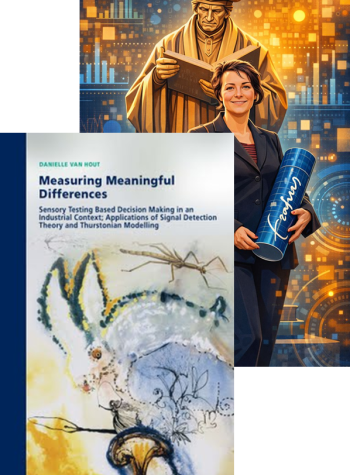
Doctoral research at Erasmus University Rotterdam, based on work conducted at Unilever R&D with academic partners, focused on improving the effectiveness of industrial sensory product testing.
Sensory results are widely used to support product decisions, but they are based on human responses and therefore inherently variable. This makes it difficult to determine to what extent observed differences reflect real product effects versus variability introduced by the measurement.
The research showed that conventional statistical approaches do not explicitly account for this, and that outcomes can depend on the method used. As a result, findings are often difficult to compare across studies or build into cumulative knowledge.
By applying Signal Detection Theory and Thurstonian modelling alongside traditional methods, it becomes possible to separate true differences from variability and express results on a comparable scale.
Importantly, this also enables a clearer link between sensory panel results and consumer perception, helping to understand when differences measured in the lab are likely to be noticeable and relevant for consumers.

Research collaborations

Ongoing research collaborations focus on the development and application of improved methods for sensory and consumer research, often in partnership with academic researchers and institutions.
This work builds on earlier research and extends into areas such as difference testing, consumer measurement, and the interpretation of sensory data. A key focus is understanding how test design and analytical approaches influence the quality, sensitivity, and interpretability of results.
These collaborations help to further develop approaches that are both scientifically robust and applicable in practice, contributing to methods that support more reliable decisions and more consistent use of data across studies and contexts.
universities collaborations

Publications

publications nw
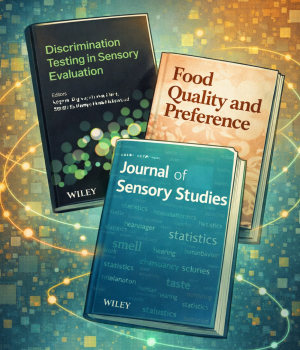
Publications focus on improving how sensory data is generated, interpreted, and used in decision-making.
A central theme is the application of Signal Detection Theory to sensory and consumer research, enabling the quantification of differences and improving comparability across methods and studies. This work also examines how measured differences relate to meaningful consumer outcomes.
In addition, the research investigates how test design factors — such as task structure, familiarization, and context — influence data quality, sensitivity, and interpretation.
More recent work extends into how context, expectations, and cognitive processes shape consumer perception and the interpretation of results.
A full overview of publications is available on LinkedIn.

Invited talks and teaching

Contributions to the field include invited talks, guest lectures, and teaching activities focused on bridging sensory science and decision-making in practice.
This includes lectures at universities, conference presentations, and workshops, as well as contributions to professional platforms such as the Institute of Food Technologists (IFT) and industry training programs. Topics typically address the design and interpretation of sensory and consumer studies, the application of signal detection theory, and the implications of methodological choices for data quality and decision-making.
These sessions aim to make underlying principles more transparent and accessible, and to support practitioners in applying methods in a way that leads to more interpretable data and more consistent, evidence-based decisions.

Methods and frameworks

cwu correct
The research, developed in collaboration with academic partners, is grounded in methodological principles for designing, interpreting, and connecting sensory and consumer data.
A central element is the application of Signal Detection Theory and related modelling approaches to quantify differences, separate signal from noise, and make results comparable across studies and methods. This is combined with a strong focus on test design, ensuring that tasks, response formats, and experimental structures support interpretable and reliable data.
Building on these principles, approaches such as the Degree of Satisfaction Difference (DOSD) framework and the Double-Faced Applicability (DFA) method have been developed to capture consumer responses more effectively and reduce non-informative variability.
Together, these methods support a consistent, quantitative understanding of product differences and more reliable interpretation of results.
This scientific foundation shapes how data is designed, interpreted, and applied in practice.