Insights & Activities

Dee-Prime contributes to the wider sensory and consumer science community through conferences, guest lectures, articles, interviews and collaborative activities.
This page brings together selected contributions since Dee-Prime’s founding in 2019, reflecting the ideas, methods and questions that continue to shape our work today.
Guest lecture | November 2025 | Dutch Sensory NIMA B Course
dutch sensory course
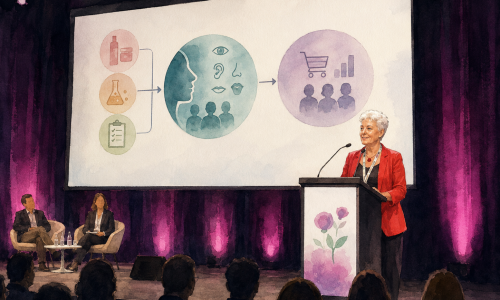
Measuring what’s real: smarter data through Signal Detection Theory
A guest lecture for the advanced Dutch Sensory NIMA B programme explored how Signal Detection Theory can strengthen sensory and consumer research.
The session focused on moving beyond significance testing towards effect sizes and signal–noise thinking to improve test design, interpretation and product-change decisions. Using practical examples from discrimination, hedonic and descriptive methods, it also showed how more comparable and interpretable data can strengthen the bridge from product characteristics to consumer response, and provide a better foundation for knowledge reuse and AI-enabled research.
Guest lecture: Measuring What’s Real — Smarter Data and a Bridge to AI through Signal Detection Theory
Book chapter | January 2025
Improving the validity of multi-product consumer tests
A new book chapter, co-authored with Professor Hye-Seong Lee and Professor Min-A Kim, explores how Cognitive Warm-Up and Signal Detection Theory can strengthen the validity of consumer testing with multiple products.
Multi-product tests are particularly vulnerable to contextual influences such as range and order effects, which can obscure real product differences. The chapter examines how Cognitive Warm-Up can help stabilize consumers’ internal frames of reference, while Signal Detection Theory separates product-related signal from response noise. Together, the approaches can improve the sensitivity, consistency and interpretability of consumer data.
Chapter: Cognitive Anchoring and Signal Detection — Enhancing Validity in Multi-Product Consumer Tests
cons res book
Conference presentation | September 2024 | Dublin, Ireland
eurosense dublin
Unlocking global consumer insights with Signal Detection Theory
A presentation at EuroSense 2024 in Dublin explored how Signal Detection Theory can strengthen consumer research across markets.
The presentation examined the limitations of conventional hedonic scales for cross-study and cross-market interpretation, and showed how SDT-based measures can add more interpretable information on consumer acceptance, sensitivity to product differences and effect size. Practical case studies illustrated how these measures can complement traditional consumer data and support better data quality, knowledge reuse and decision making in global product development.
Presentation: Unlocking Global Consumer Insights — The Role of Signal Detection Theory in Consumer Research
Book contribution | August 2024
Advancing discrimination testing through Signal Detection Theory
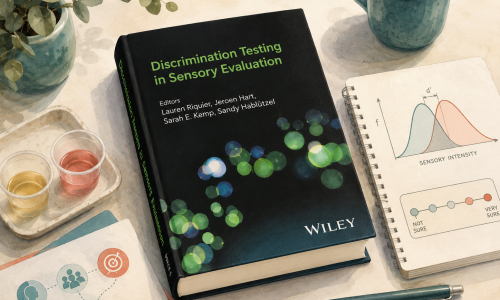
Two chapters in Discrimination Testing in Sensory Evaluation, edited by Lauren Rogers, Joanne Hort, Sarah E. Kemp and Tracey Hollowood, explore applications of Signal Detection Theory in sensory discrimination research.
One chapter, co-authored with Professor Hye-Seong Lee, focuses on sureness judgements and R-index analysis, showing how confidence information can provide richer insight into discrimination performance and response behaviour.
A second chapter, co-authored with Professor Hye-Seong Lee and Professor Min-A Kim, examines sensory quality measurement using SDT-based discrimination methods, including reference-based testing, d′ measures and approaches for evaluating test performance.
Chapters: Sureness Judgements and R-Index Calculations and Their Applications; Sensory Quality Measurement Based on SDT Discrimination

discr book
Conference presentation & workshop | June 2024 | Paris, France
sensometrics 2024
From better consumer data to stronger sensory quality decisions
At Sensometrics 2024 in Paris, a conference presentation and workshop explored practical applications of Signal Detection Theory in sensory and consumer science.
The presentation, From Global Diversity to Data Unity, examined how SDT-based consumer measures can complement conventional hedonic data by providing more interpretable effect sizes, information on consumer sensitivity and acceptance, and measures that are easier to compare and combine across studies and markets.
The workshop focused on reference-based discrimination testing for sensory quality management. It showed how measures such as d′, reference recognition and response bias can be used not only to quantify product differences, but also to assess test quality, define consumer-relevant action standards and build more reliable data for knowledge reuse and predictive modelling.
Contributions: From Global Diversity to Data Unity — Signal Detection’s Role in Consumer Research; Enhancing Sensory Quality Management with Reference-Based Discrimination Tests
Interview & podcast | February–March 2024 | Institute of Food Technologists
The State of Sensory Science
An IFT Food Technology feature, The State of Sensory Science, brought together perspectives on the development and future of the discipline, including a conversation with Professor Julien Delarue of the University of California, Davis.
The discussion explored the challenges of measuring human perception, the relationship between academic research and industry practice, and how sensory science can support better product and business decisions. It also looked ahead to the growing importance of data quality, reusable knowledge and AI-enabled approaches in sensory and consumer research.
The conversation continued in IFT’s Omnivore podcast, Episode 31, with a broader discussion of sensory science and how the field continues to evolve.
Featured in: The State of Sensory Science, Food Technology; Omnivore Podcast, Episode 31
ifp podcast
Guest lecture | October 2023 | Wageningen University & Research, The Netherlands
wageningen 2024
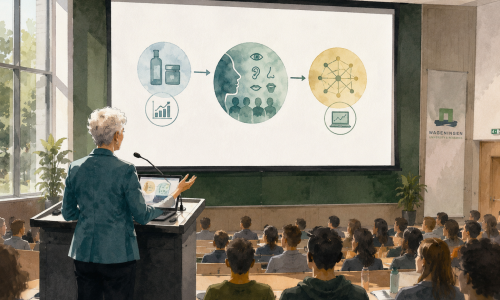
The Digital Sense: how AI is shaping sensory science’s future
A guest lecture at Wageningen University & Research explored how artificial intelligence and digital technologies could reshape sensory and consumer science.
Drawing on experience across research, industry and consultancy, the lecture examined how sensory science can act as a bridge between product, analytical, consumer and market data. It also addressed what is needed to make AI genuinely useful in practice: high-quality data, effective knowledge management, appropriate modelling approaches and the right scientific capabilities.
Guest lecture: The Digital Sense: How AI is Shaping Sensory Science’s Future
Conference contribution | August 2023 | Nice, France
Sensory science as a bridge in digital transformation
At the 2023 Pangborn Sensory Science Symposium in Nice, the oral session on Digital brought together research on augmented reality, AI, machine learning, Bayesian modelling and social media analytics in sensory and consumer science. Danielle co-chaired the session.
In a workshop organised by the European Sensory Network, participants from CPG companies, research agencies and academia explored the unique role of sensory and consumer science in connecting product formulation and analytical information with consumer experience and market performance. The workshop examined how better-connected and well-structured data could enable knowledge reuse, predictive modelling, simulated experimentation and virtual prototyping, and provided the foundation for a subsequent scientific publication.
Contributions: Co-chair, Digital oral session; workshop presentation, Sensory as a Bridge
pangborn 2023
Virtual presentations & teaching | 2021–2022 | International
vir conf 20212
Exploring AI and the digital transformation of sensory science
During 2021 and 2022, as conferences and professional events moved online, a series of international presentations, guest lectures and workshops explored how AI and digital technologies could reshape sensory and consumer research.
Across events including Pangborn, EuroSense, IFT FIRST, AIFST and the European Sensory Network, as well as academic sessions at Ewha Womans University, Wageningen University and Inholland, topics ranged from AI-enabled research workflows and knowledge management to capability building and the broader digital transformation of the discipline.
Topics included Improving the Sustainability of Consumer Research Through an AI-Powered Workflow, AI-Powered Research: Application of Knowledge Management Systems to Make Smarter Research Plans, and Assessing Your Consumer and Sensory Science Team’s AI Capabilities.
Conference research | July 2019 | Edinburgh, UK
Signal detection approaches to consumer satisfaction and segmentation
At the 2019 Pangborn Sensory Science Symposium, two collaborative studies with researchers from Ewha Womans University explored new applications of Signal Detection Theory in consumer research.
One study introduced an attribute-specific version of the Degree of Satisfaction Difference method, designed to assess whether consumers are satisfied with a particular sensory attribute rather than relying solely on conventional liking scores. The second combined satisfaction and discrimination measures to identify consumer sensory segments and quantify both the opportunity and risk associated with product change.
Research presented: The Attribute-Specified Degree of Satisfaction-Difference Method for Measuring Consumer Acceptance Focusing on a Specified Sensory Attribute; Sensory Segmentation Using SDT Measures: A New Approach for Market Development
pangborn 2019
Guest lecture | June 2019 | Seoul, South Korea
Ewha guest teaching
Sensory & consumer science in the FMCG industry
A guest lecture at Ewha Womans University explored the role of sensory and consumer science in FMCG innovation, using Danielle’s career across research and industry as a lens through which to reflect on how the discipline has evolved.
The lecture connected scientific methodology with practical R&D decision making, covering Signal Detection Theory, discrimination testing, consumer satisfaction and sensory segmentation, alongside emerging opportunities around digital knowledge and big data. It also reflected on how scientific depth, curiosity, leadership and long-term collaboration can shape both research practice and innovation.
Guest lecture: Sensory & Consumer Science in the FMCG Industry
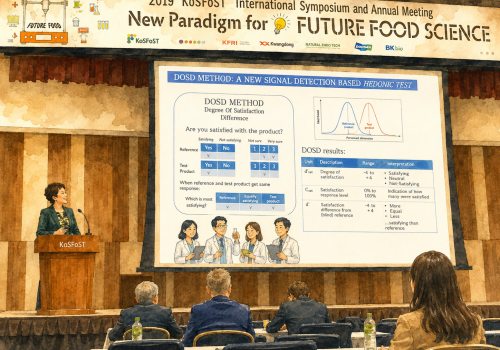
Conference presentation | June 2019 | Incheon, South Korea
From signal detection to better decisions and reusable data
At the 2019 KoSFoST International Symposium, work from the long-standing collaboration between Unilever and Ewha Womans University explored how Signal Detection Theory could strengthen sensory and consumer research.
The presentation focused on moving beyond significance testing towards estimating meaningful effect sizes, and showed how SDT-based approaches such as DOSD and DFA could provide more interpretable and comparable data. It also looked ahead to how research outcomes could be reused in digital knowledge bases and, ultimately, predictive models.
Presentation: New Signal Detection Methods for Better Decision Making, Big Data and Predictive Models
kosfost (2)
Sharing ideas, exchanging perspectives, and advancing sensory and consumer science together.