When Does a Sensory Difference Become Noticeable to Consumers?
Relating trained panel and consumer sensitivity to define consumer-relevant action standards
The Challenge

Trained sensory panels are designed to detect small product differences.
That sensitivity is extremely valuable for product development, quality and reformulation. But it also creates a decision challenge:
A difference detected by a trained panel is not necessarily a difference consumers will notice.
Using the panel result alone can therefore make it difficult to judge how much product change is acceptable. Very strict sensory specifications may trigger additional testing or technical work even when the difference is unlikely to be perceptible to consumers.
The real question is therefore:
What does the sensory difference mean for consumers?
The Approach
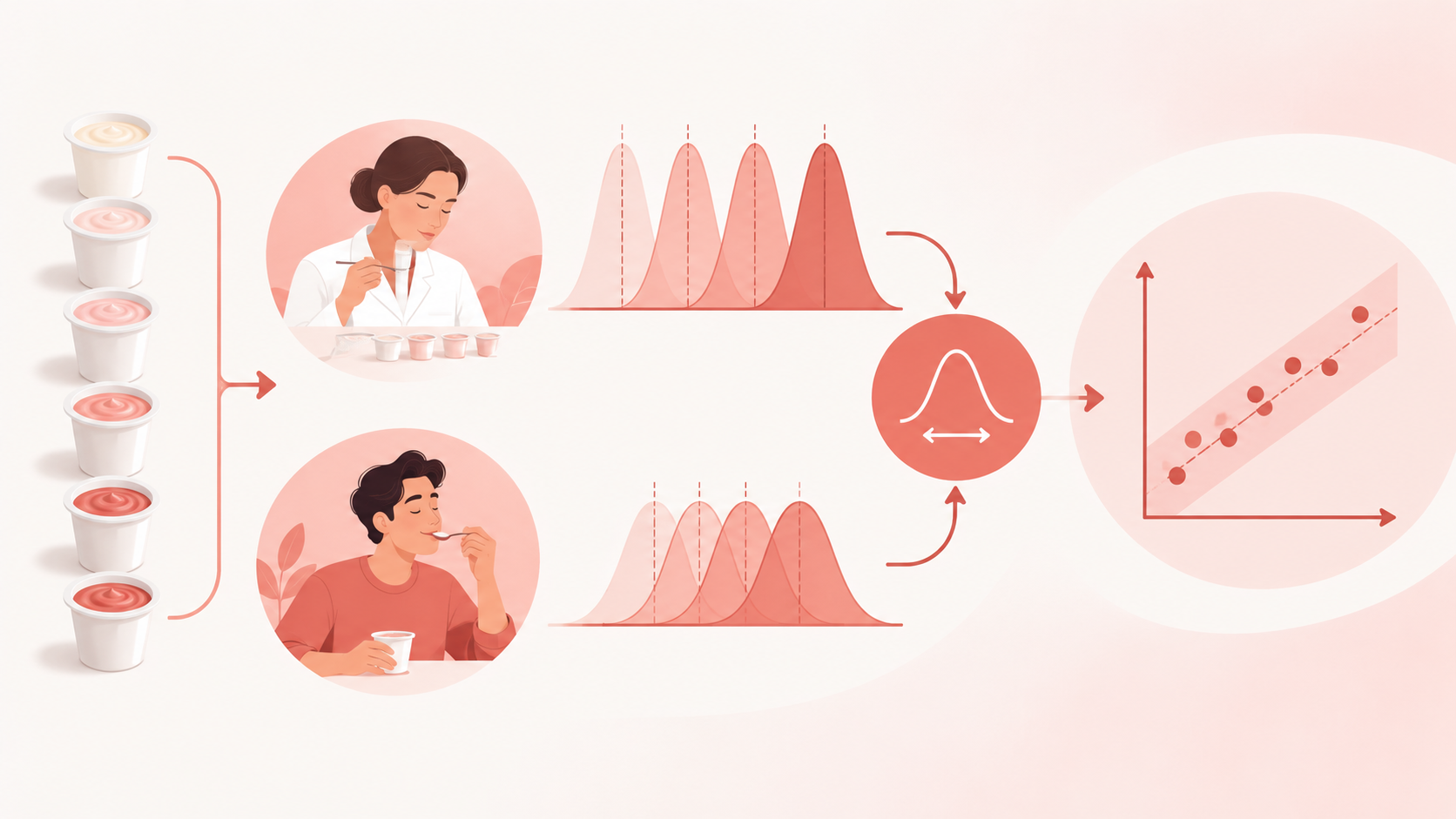
A series of products were evaluated independently by an experienced trained sensory panel and by consumers.
The two groups were intentionally very different. The trained panel was highly experienced and tested under controlled conditions, while the consumer sample represented normal consumer sensitivity.
Importantly, comparability did not depend on using the same test method. Each group could be assessed using the method most appropriate for its role and level of sensitivity.
To make the results directly comparable, sensory differences were expressed using d′, a standardized measure of perceptual difference derived from Signal Detection Theory.
This created a common measurement framework in which panel and consumer sensitivity could be compared, even when different test methods were used, and the relationship could be modelled.
From panel difference to consumer sensitivity

As expected, the trained sensory panel detected substantially larger differences than consumers.
But the results were related: products that showed larger differences in the sensory panel also tended to show larger perceptual differences among consumers.
This relationship made it possible to translate a sensory-panel result into an estimate of consumer detectability.
Instead of applying an arbitrary sensory threshold, action standards could therefore be linked to the level of difference consumers were likely to perceive.
Better action standards, more efficient testing
The case study showed how calibration between panel and consumer sensitivity can improve decision making.
A difference detected by a trained panel does not always mean consumers are likely to notice it. By linking panel results to consumer sensitivity, action standards can be set around consumer relevance rather than panel sensitivity alone.
This turns the trained panel into a predictive screening tool for product change, supporting more meaningful specifications, better reformulation decisions, more targeted consumer research and faster, more efficient testing.

Building reusable knowledge